How to count calories in a home-cooked meal

Short answer
Log the whole recipe once, then take your share. Weigh or measure each ingredient, including the cooking oil, and add up the calories. Divide by the number of servings, or weigh the finished dish and your portion for a fairer split. Match raw weights with raw entries and cooked weights with cooked ones, because cooking adds or removes water and changes calories per gram.
On this page
What's the most accurate way to log a recipe?
Weigh each ingredient as it goes in and look it up. That is how Google's Nutrition5k researchers built true calorie values for about 5,000 cafeteria dishes: they weighed every item as it was added to the plate and multiplied by its per-gram values from a USDA food database.
At home, the same idea works in four steps:
- List every ingredient, including oil, butter, sauces and anything you sprinkle on at the end.
- Weigh or measure each one, and note whether it was raw or cooked when you weighed it.
- Add up the calories using a matching entry for each ingredient.
- Divide the total by the number of servings, or by weight if portions differ.
The 2025–2030 Dietary Guidelines encourage home-prepared meals, and the recipe method is what makes them easy to log. You do the arithmetic once, and every leftover serving after that is quick.
Why do raw and cooked weights matter?
Because cooking changes how much water a food holds, so the same food has very different calories per gram raw and cooked. According to USDA FoodData Central:
| Food, per 100 g | Raw or dry | Cooked | Water, raw to cooked |
|---|---|---|---|
| Long-grain white rice | 365 kcal | 130 kcal | 12% → 68% |
| Pasta | 371 kcal | 158 kcal | 10% → 62% |
| Chicken breast, skinless | 120 kcal | 165 kcal (roasted) | 74% → 65% |
Rice and pasta soak up water, so their calories per gram fall. Chicken loses water, so its calories per gram rise. Mixing the two up causes big errors. Weighing 100 grams of cooked rice but logging it as dry rice counts 365 calories instead of 130, nearly three times too many. Weighing chicken raw but choosing the roasted entry overcounts by about 38 percent.
What does that look like for a real recipe?
Take a chicken, rice and broccoli stir-fry for 4, with every ingredient weighed raw. Using USDA values:
- 500 g raw chicken breast: about 600 calories
- 185 g raw long-grain white rice (1 cup): about 675 calories
- 182 g raw broccoli (2 cups chopped): about 62 calories
- 27 g olive oil (2 tablespoons): about 239 calories
The pot comes to about 1,576 calories, or about 394 per serving if you split it evenly. The two tablespoons of oil alone are about 15 percent of the total, nearly four times the calories of all the broccoli.
If people take different amounts, weigh the finished dish instead. Say the stir-fry weighs 1,400 grams when it's done. That's about 1.13 calories per gram, so a 300-gram portion is about 338 calories.
What if you don't want to weigh everything?
Measure the ingredients that carry the most calories and estimate the rest. Oil, butter, cheese, nuts, meat, rice and pasta are worth a spoon, cup or scale. Vegetables like the broccoli above change the total very little.
For ingredients with a label, such as sauces, use the label and the amount you poured. For recipes you make often, log the whole pot once and reuse it, so the effort pays off every time you cook it again.
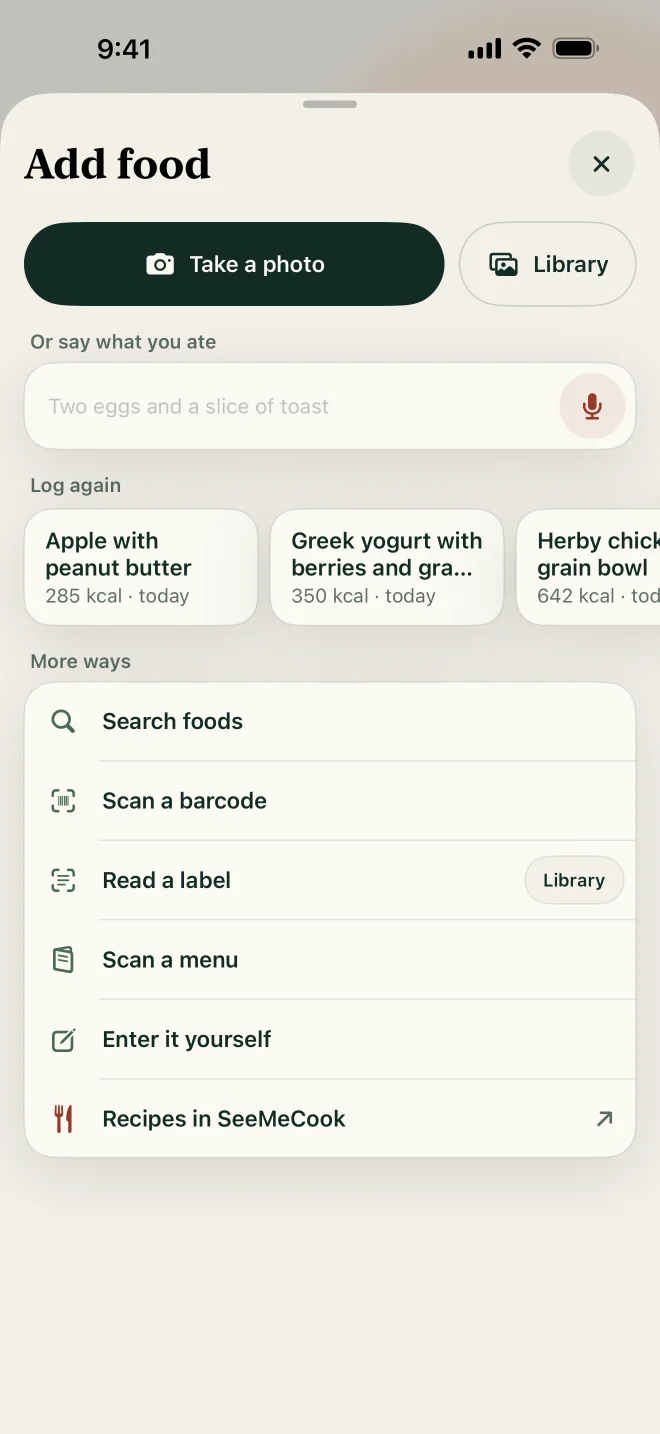
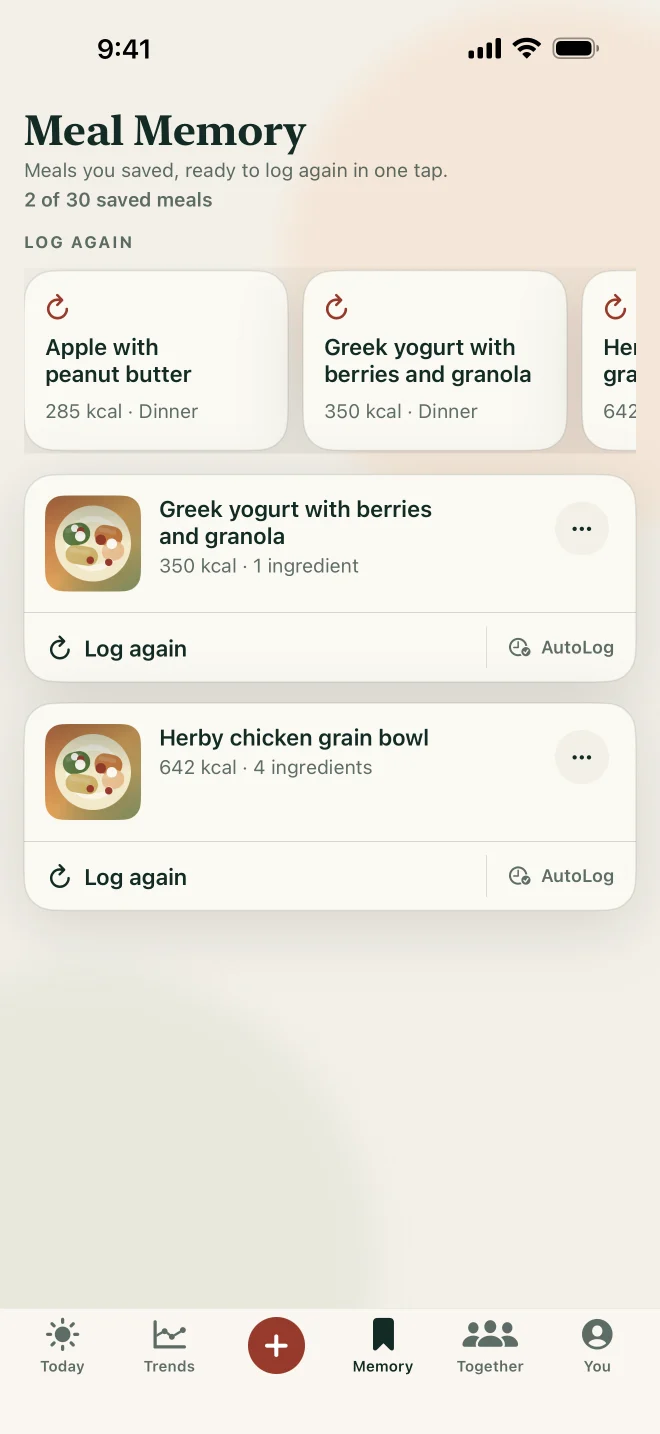
Screens from the iPhone app with demo data.
Common questions
Should I weigh ingredients raw or cooked?
Either works, as long as the entry you choose matches. Weighing raw and using raw entries is often simplest for recipes, because you measure everything before it goes into the pot.
How do I count the oil left in the pan?
Count all of it unless you measure what's left. You can't see how much soaked into the food, so logging the full amount is the cautious choice.
How do I log a dish someone else cooked?
Pick the closest matching entry or take a photo, then add the fats you can see or taste. Ask the cook what went in if you can, especially the oil and butter.
Sources
- Thames Q, Karpur A, Norris W, et al. Nutrition5k: Towards Automatic Nutritional Understanding of Generic Food. CVPR. 2021. openaccess.thecvf.com
- U.S. Department of Agriculture and U.S. Department of Health and Human Services. Dietary Guidelines for Americans, 2025–2030. cdn.realfood.gov
- U.S. Department of Agriculture, FoodData Central. Rice, white, long-grain, regular, raw, unenriched (FDC ID 169756). fdc.nal.usda.gov
- U.S. Department of Agriculture, FoodData Central. Rice, white, long-grain, regular, unenriched, cooked without salt (FDC ID 169757). fdc.nal.usda.gov
- U.S. Department of Agriculture, FoodData Central. Pasta, dry, unenriched (FDC ID 168927). fdc.nal.usda.gov
- U.S. Department of Agriculture, FoodData Central. Pasta, cooked, unenriched, without added salt (FDC ID 168928). fdc.nal.usda.gov
- U.S. Department of Agriculture, FoodData Central. Chicken, broiler or fryers, breast, skinless, boneless, meat only, raw (FDC ID 171077). fdc.nal.usda.gov
- U.S. Department of Agriculture, FoodData Central. Chicken, broilers or fryers, breast, meat only, cooked, roasted (FDC ID 171477). fdc.nal.usda.gov
- U.S. Department of Agriculture, FoodData Central. Broccoli, raw (FDC ID 170379). fdc.nal.usda.gov
- U.S. Department of Agriculture, FoodData Central. Oil, olive, salad or cooking (FDC ID 171413). fdc.nal.usda.gov
Estimates, not medical advice. If you're pregnant, have a medical condition or have a history of disordered eating, talk to a clinician before changing how you eat.
Written by the SeeMeEat editorial team under a pen name.